The site starts
with us.
Earthworks for builders & developers — Adelaide & the Adelaide Hills
Act I of IV — Excavation & site clearing
The Cut.
Stripped, cut and carted to certified levels. The operator you see is ours; so is the machine. The site gives up exactly what the drawings ask of it.
Act II of IV — Earthworks & drainage
The Water.
Pads, benching, stormwater and ag lines — fall-tested before anything is buried. Water always wins; we route it first.
Act III of IV — Civil retaining
The Hold.
Engineered walls at commercial scale — sleeper, block and rock — with drainage behind every course that needs it. Engineered, drained and documented.
Act IV of IV — Civil fencing
The Line.
Security, rural and site boundary lines — posts concreted to depth, strung and sighted before a single panel hangs.
Groundworks, since the first peg
Every build that has ever stood has stood on ground someone prepared.
The fleet
Our own iron.
Owned, maintained, on our floats — not hired in on the morning. Makes, models and attachments publish here from the real plant list.
Excavator
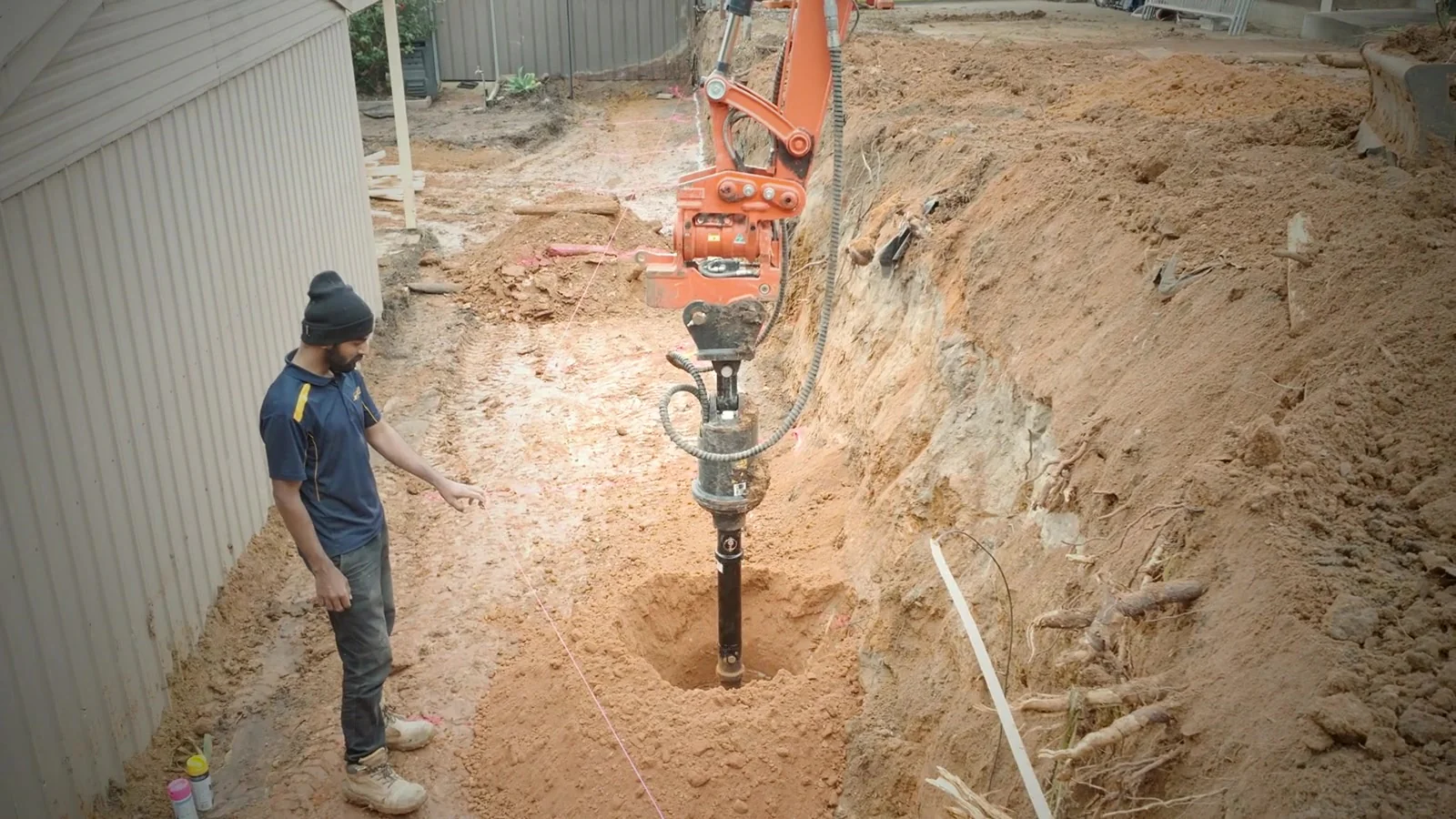
Kubota KX040-4 — seen in Act I
Buckets · auger · ripper
Attachments
Auger drive — seen in the hero
Full list publishing soon
Cartage
Publishing with the plant list
The four acts, on your drawings
Civil work, from the first cut to the last line.
AOI Civil takes on the ground package for builders, developers and owners: the site cut and clearing, earthworks and drainage, engineered retaining, and the civil fencing that closes a development out. Each discipline is priced against your drawings rather than guessed from a phone description, and delivered by our own machines and our own operators.
The four are usually bought together on a development and separately on a rebuild. Either way the sequence matters: clearing and cut first, pad and stormwater next, retaining before a fence line goes on top of it, fencing last. We plan that order with you so the trades that follow us aren't waiting on each other, and so the inspection that gates the next stage is booked before it's needed.
It's earthworks for builders and developers across Adelaide and the Adelaide Hills — from tight infill blocks in Norwood and Prospect, to the foothill slopes at Burnside and Mitcham, and out to the growth fronts on the edge of the city.
Scoping & pricing
How earthworks and retaining are priced in Adelaide.
Adelaide is not one set of ground conditions. Inside a single council area the profile can run from sand over limestone to high-plasticity clay that swells and shrinks with the seasons, and in the Adelaide Hills it turns to shallow rock and winter-wet clay within a suburb. Machine selection, batter angles and compaction all follow the ground — which is why we walk the site before we put a number to it.
A price built from a drawing alone is a guess about what is under the surface. Ours starts from three things: the drawings and finished levels, the geotechnical report and site classification for the lot, and a walkover of the actual access. From those we can price the cut, the cart-off per load with tip fees stated, the pad, the drainage runs and any retaining — and name the machine in the scope so you know what is turning up.
Where the ground disagrees with the report — rock where clay was expected, old fill under a backyard — we stop, price the change with you in writing, and only proceed on approval. Rock is handled as a documented variation with evidence, never absorbed into a mystery invoice. That is the difference between a quoted scope and an argument at the end of the job.
Sloping blocks live or die on the cut-and-fill balance: cart-off you did not need, or fill you did not have. On the foothills at Burnside and Mitcham we model that balance before the first bucket so the earthworks bill is a plan rather than a surprise, and on the flat northern plains at Salisbury and Angle Vale the same discipline goes into levels and fall, because flat ground needs drainage set deliberately rather than left to find its own way.
Areas we work in — Adelaide & the Hills
Straight answers — Adelaide & the Hills
Do you work outside the metropolitan area?
Yes. We work across Adelaide and the Adelaide Hills and out to the growth fronts on the edge of the city — Mount Barker, Riverlea at Buckland Park, Two Wells, Roseworthy, Gawler East and Concordia, Angle Vale, Aldinga and Strathalbyn — within a service circle of roughly 60 km from the CBD. Murray Bridge and Gifford Hill sit at the outer edge of that circle. Travel and mobilisation are priced upfront rather than added at invoice time.
What happens if you hit rock?
We stop and price the change with you in writing before continuing. Rock found where the geotechnical report did not predict it is a documented variation with evidence, not a quiet addition to the final bill. It changes the machine, the time and the price, and you hear about all three before the work proceeds.
Do your retaining walls come with engineering?
Walls over the height and loading thresholds are built to engineering documentation — either yours or arranged through our engineers — with drainage behind every course and inspections at the hold points the design requires. Concrete sleeper, masonry block and rock are all options; load, height, access and budget decide which is right.
Can you produce levels my certifier will sign off?
Yes. Final levels are checked against the design, and the completion documentation — level and compaction results for pads, test results where the engineer specifies them — is provided for your certifier and for the trades that follow us onto the site.
We are on a sloping block in the Hills. Can you handle the benching?
Sloping sites are core work: benching, batters, cut-off drains above pads and ag lines behind retaining, all built to the engineer's detail. On Hills ground we price from the site walkover and the geotech report, because rock depth and winter-wet clay change both the method and the programme. Where a large tree is protected under the state's regulated and significant tree rules, we check the work area against that advice before a root is cut.
Do you build the fence on top of a retaining wall?
Yes — that interface is exactly where we work. Posts sleeve into the wall structure, plinth details and drainage are coordinated because the wall and the fence come from one contractor rather than two trades arguing over a boundary. On boundary fencing we are straight about the Fences Act: notices, shared costs and honest scoping before work starts.
Commission pricing — 60 seconds
Send the drawings.
A priced scope returns.
Machine, operator, cartage and certification — priced against your programme window, not a callback queue. Builders, developers and owners across Adelaide and the Hills.